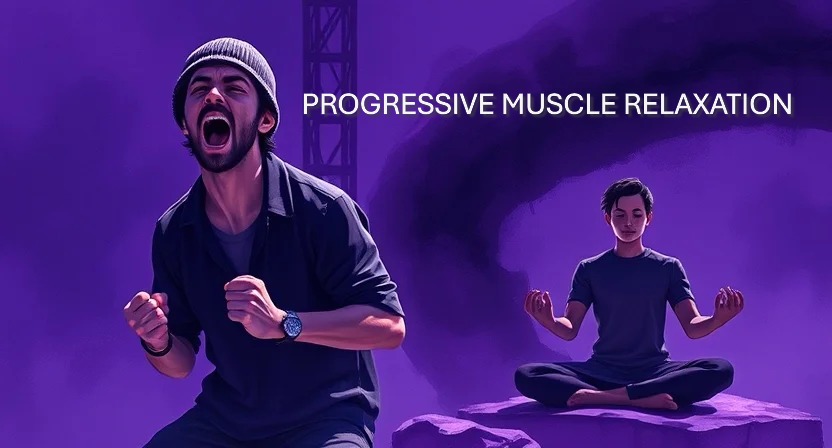

"Lean into your tension, get comfortable with it, only to let it go. Then, you can know true relaxation."
General Steps
- Find a comfortable position, either sitting or lying down
- Take in a slow deep breath and hold it
- Tense your muscles
- Hold the breath and tension for ~5 seconds
- Focus on how this tension feels in your body
- Forcefully exhale all your breath while letting go of the tension
- Focus on how this new feeling of relaxation contrasts to that of the tension
- Allow yourself to enjoy this relaxation for ~10 seconds while breathing normally
- Repeat the steps above until you have done every muscle in your body
Sequence
Work through these muscle groups in order:
- Feet - Curl your toes downward
- Calves - Point your toes upward towards your knees
- Thighs - Squeeze your thighs together
- Buttocks - Clench
- Stomach - Curl yourself into a crunch
- Chest - Cross your arms to flex your pectorals
- Hands - Clench your fists
- Forearms - Curl your wrists
- Biceps - Curl your arms
- Shoulders - Shrug towards your ears
- Neck - Push your head back into your head rest
- Face - Scrunch your face
- Whole Body - Tense every muscle in your body
History
Invented by Edmund Jacobson: PMR was developed by American physician Edmund Jacobson in the early 1920s. He introduced it as a way to reduce anxiety and stress, based on his research suggesting that physical tension was linked to emotional stress.
Early research: Jacobson's initial work focused on the relationship between muscle tension and emotional states. He found that by intentionally tensing and then relaxing muscles, individuals could achieve a deeper sense of relaxation and manage stress more effectively.
Published work: Jacobson's 1938 book, Progressive Relaxation, outlined the technique and its applications, laying the groundwork for its widespread use in both medical and psychological fields.
Treatments
PMR is widely used to address both physical and psychological health concerns, including:
- Anxiety and stress disorders
- Insomnia and sleep difficulties
- Chronic pain management
- Muscle tension and headaches
- High blood pressure
- Depression symptoms
Benefits
- Reduces physical tension and muscle pain
- Lowers anxiety and stress levels
- Improves sleep quality
- Enhances body awareness
- Can be practiced anywhere, anytime
- No special equipment needed
Caveats
- Avoid tensing muscles if you have injuries in that area
- Not recommended for those with certain medical conditions (such as severe muscle disorders or cardiovascular issues) without consulting a doctor first
- May initially increase awareness of tension before providing relief
- If you experience pain during the exercises, stop immediately and consult a healthcare professional
References
- Jacobson, E. (1938). Progressive Relaxation. University of Chicago Press.
- Mayo Clinic. Relaxation techniques: Try these steps to reduce stress.