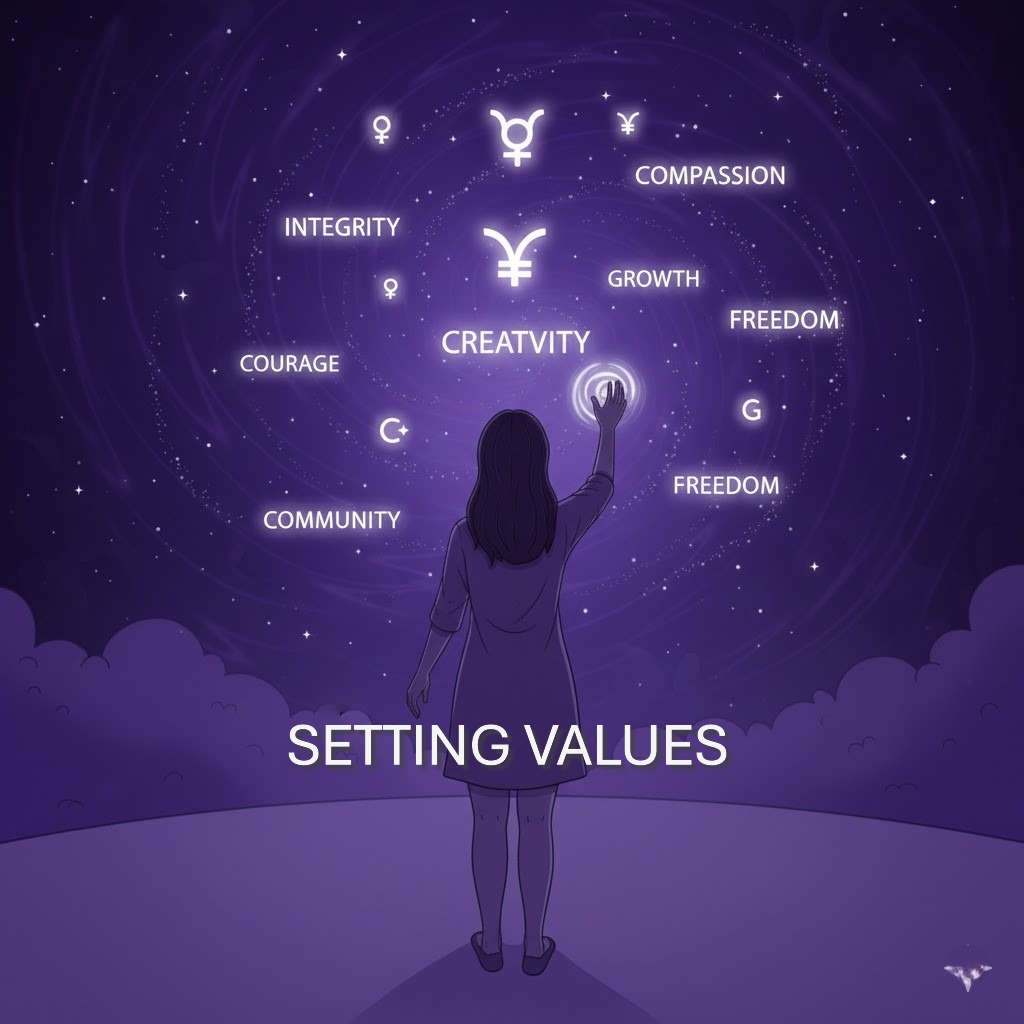
What do you want your life to stand for? Values are the principles and qualities that guide how we want to live and who we want to be. Unlike goals (which can be achieved), values are ongoing directions that shape every choice we make.
What Are Values?
Values are:
- Chosen directions, not destinations
- Qualities of action—how you want to behave and engage with life
- Personal and freely chosen—not imposed by others
- Present-focused—you can live by a value right now
Values differ from goals. A goal is something you achieve (run a marathon); a value is how you live (be active and challenge myself physically). Goals end; values continue.

"Your beliefs become your thoughts, Your thoughts become your words, Your words become your actions, Your actions become your habits, Your habits become your values, Your values become your destiny."
Why Values Matter
Research in Acceptance and Commitment Therapy (ACT) and positive psychology shows that values-based living is associated with:
- Greater life satisfaction and meaning
- Increased resilience during difficult times
- Better decision-making
- More intrinsic motivation
- Reduced anxiety and depression
- Stronger sense of identity
When our actions align with our values, even hard things feel meaningful. When they don't, even easy things feel empty.
How to Identify Your Values
Exercise 1: Life Domains
Consider these areas of life and what matters to you in each:
- Relationships: What kind of partner, friend, family member do you want to be?
- Work/Career: What qualities do you want to bring to your work?
- Health: How do you want to relate to your body and well-being?
- Personal Growth: What kind of person do you want to become?
- Leisure/Play: How do you want to experience rest and recreation?
- Community/Service: How do you want to contribute to the world?
- Spirituality/Meaning: What gives your life deeper purpose?
Exercise 2: Peak Experiences
- Think of a time when you felt most alive, fulfilled, or "in the zone."
- What were you doing? Who were you with?
- What values were you honoring in that moment?
- Repeat with 2-3 different peak experiences.
- Look for common themes.
Exercise 3: The 80th Birthday Speech
Imagine you're at your 80th birthday party. Someone who knows you well stands up to give a speech about who you've been and how you've lived.
- What do you hope they would say about you?
- What qualities would you want them to describe?
- What impact would you want to have had?
Exercise 4: Values Card Sort
- Review a list of values (see below).
- Select 15-20 that resonate with you.
- Narrow down to your top 10.
- Prioritize to find your top 5 core values.
Common Values (Sample List)
- Authenticity, Adventure, Balance, Compassion, Courage
- Creativity, Curiosity, Fairness, Family, Freedom
- Generosity, Gratitude, Growth, Health, Honesty
- Humor, Independence, Integrity, Justice, Kindness
- Knowledge, Leadership, Love, Loyalty, Mindfulness
- Nature, Openness, Peace, Persistence, Playfulness
- Reliability, Respect, Responsibility, Security, Service
- Simplicity, Spirituality, Stability, Trust, Wisdom
Living Your Values
Making Values Actionable
For each of your core values, identify:
- Specific behaviors: What actions express this value?
- Daily opportunities: Where can you practice this value today?
- Obstacles: What gets in the way? How will you handle it?
Values Compass Check
Periodically ask yourself:
- On a scale of 1-10, how aligned are my actions with this value?
- What's one small step I could take to move closer to this value?
- What would I do differently if I fully honored this value?
When Values Conflict
Sometimes values compete (e.g., family time vs. career ambition). When this happens:
- Recognize that both values are legitimate.
- Consider the context—different situations may call for different priorities.
- Look for creative solutions that honor multiple values.
- Make a conscious choice rather than defaulting to habit.
Benefits
- Clarity in decision-making: Values provide a framework for choices.
- Increased motivation: Values connect daily actions to deeper meaning.
- Resilience: Values give you something stable to hold onto during hard times.
- Authenticity: Living by your values feels genuine and satisfying.
- Better relationships: Knowing your values helps you communicate what matters to you.
- Reduced regret: Values-aligned choices are ones you can stand behind.
Caveats
- Values are chosen, not discovered: There's no "right" answer—you decide what matters to you.
- Values can change: What mattered at 20 may differ from what matters at 50. Revisit periodically.
- Living perfectly by values is impossible: The goal is direction, not perfection.
- Beware of "should" values: Choose values because they matter to you, not because you think you should have them.
- Values don't eliminate hard choices: They provide guidance, not guarantees.
References
- Harris, R. (2009). ACT Made Simple: An Easy-to-Read Primer on Acceptance and Commitment Therapy. New Harbinger Publications.
- Positive Psychology - Values Clarification Exercises
- Hayes, S. C., Strosahl, K. D., & Wilson, K. G. (2012). Acceptance and Commitment Therapy: The Process and Practice of Mindful Change. Guilford Press.